
Sumin Hyun
Align
Reimagined social connection by designing a system that makes repeated real-world encounters visible
OVERVIEW
Over the course of our lives, we cross paths with nearly 80,000 people many of whom remain familiar strangers. In fast moving daily environments, moments of recognition and potential connection often go unnoticed and unacted upon.
Align is a speculative tool that transforms these subtle social signals into a measurable experience. It introduces a score that quantifies how often and how long two people share physical space, making invisible patterns of familiarity visible and actionable to support meaningful, real-world connections.
Team
- 4 Designers
My Role
- Designer
Timeline
- 72 Hours
Tools
- Figma
- Figma Make
- Video Editing
The Challenge
Design a speculative tool that can track, measure, and visualize an aspect of human sensory experience that is currently intangible or unmeasurable. The solution must also allow users to detect, enhance, or manipulate this sensory input to support a specific wellness goal or behavior change.
The Problem
How might we make these invisible patterns of social familiarity visible so users can recognize and act on potential connections?
The Goal
Design a tool that makes social familiarity visible and measurable. By introducing a new signal of connection, the goal is to help users recognize repeated encounters and turn them into meaningful, real-world relationships.
BRAINSTORMING
Day 1: Where do we start?
Given the time constraints of the hackathon, we started by quickly generating ideas as a group after reviewing the prompt.
We shared our concepts, then narrowed them down by identifying common themes.
Narrowing it down
We then moved into refining our ideas by defining the specific sensory experience we wanted to measure.
Each team member identified 2 of their strongest concepts, and we collaboratively combined overlapping ideas to form a more focused direction.
- tracking and visualizing an internal sensory experience: the emotional residue left by dreams
- "sense of destined connection" or "future connection awareness"
DEFINE
Defining the new sense
We chose to explore a new form of perception: the ability to sense social connection through patterns of shared space and repeated encounters.
This sense is defined through three key components which informed the key features, translating abstract social signals into actionable interactions:
Feature Translation
Familiarity
Recognizing people we repeatedly see in everyday places
Map View
Visualizes repeated encounters
Serendipity
Understand when repeated encounters might not be random but instead reflect similar lifestyles
Connection Prompts
Highlights meaningful moments to engage
Pattern recognition
Identifying routines and shared behaviors with others
Astral Score
Quantifies shared time and patterns
Target Audience
Many Gen Z and young millennials (age 18-30) naturally look for connection in environments where they regularly encounter new faces but share similar experiences:
- Students on large college campuses
- Young professionals who recently moved to a new city
- People with consistent routines
- Individuals who want to expand their social circles beyond existing friend networks
FINAL PROTOTYPE

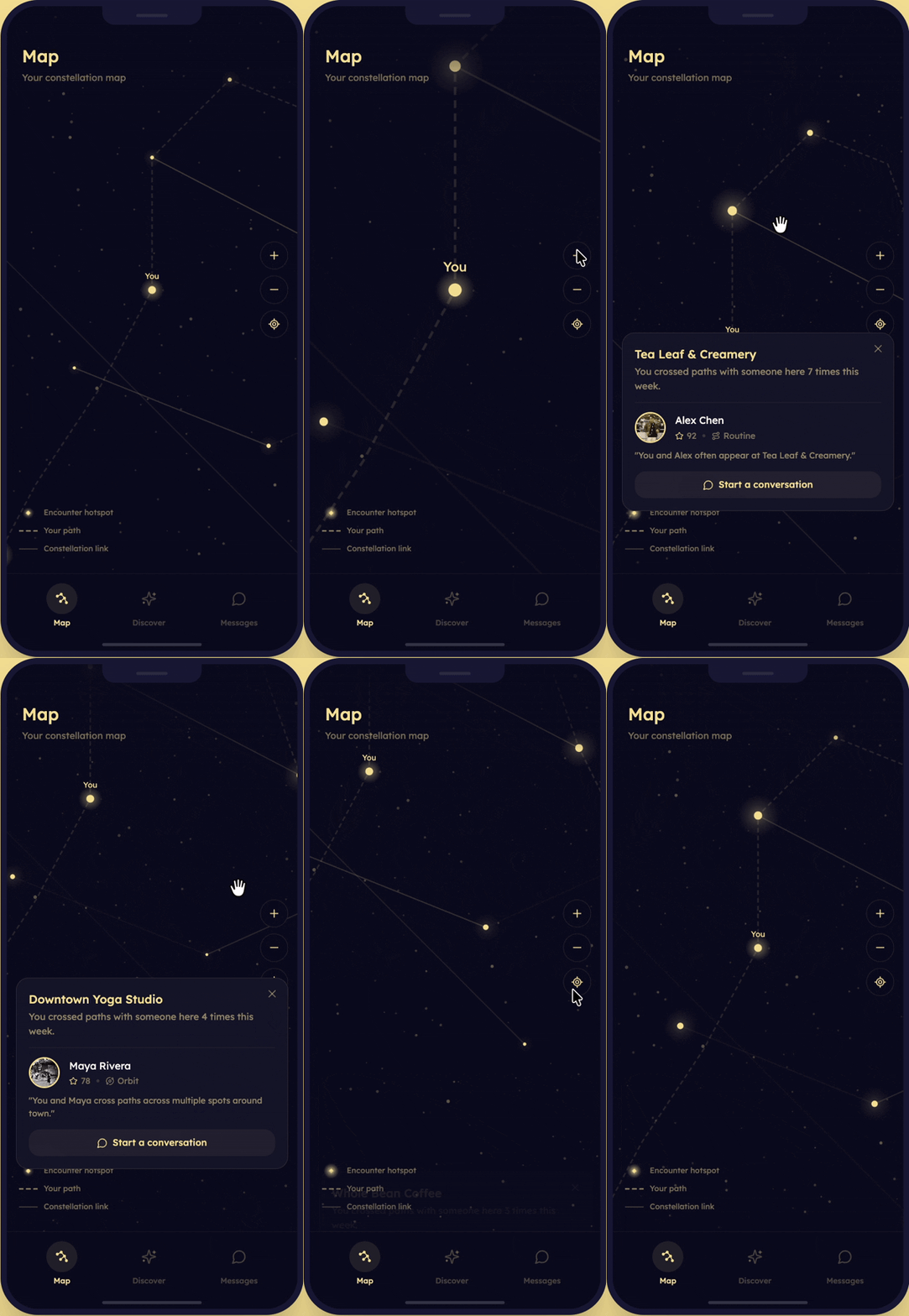
THE CONSTELLATION MAP
PATHS AND ENCOUNTERS
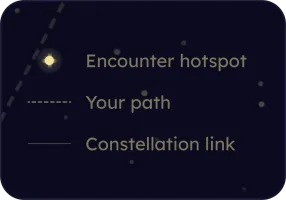
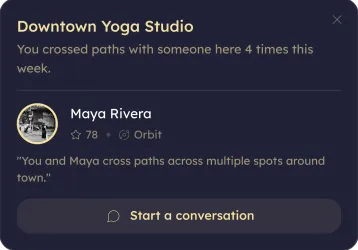
See your own path you took through the day and the people you’ve encountered visually see where you’ve encountered someone
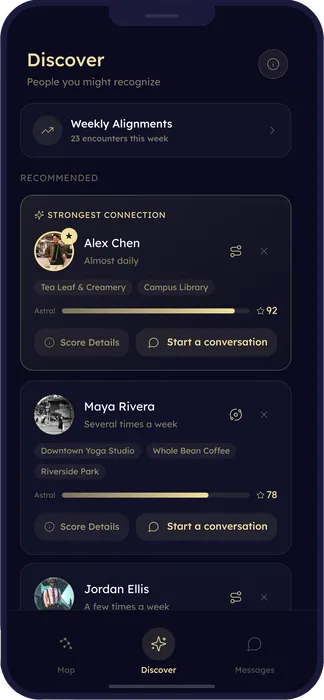
DISCOVER
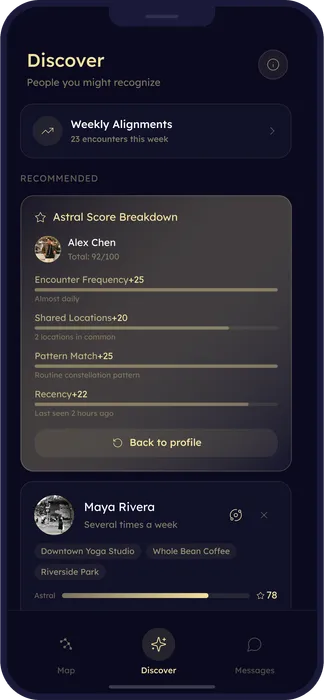
ASTRAL SCORE
See how your astral score was formed and choose to start a conversation or remove the recommendation
MESSAGE
STARLINKS AND NEW STARLINKS
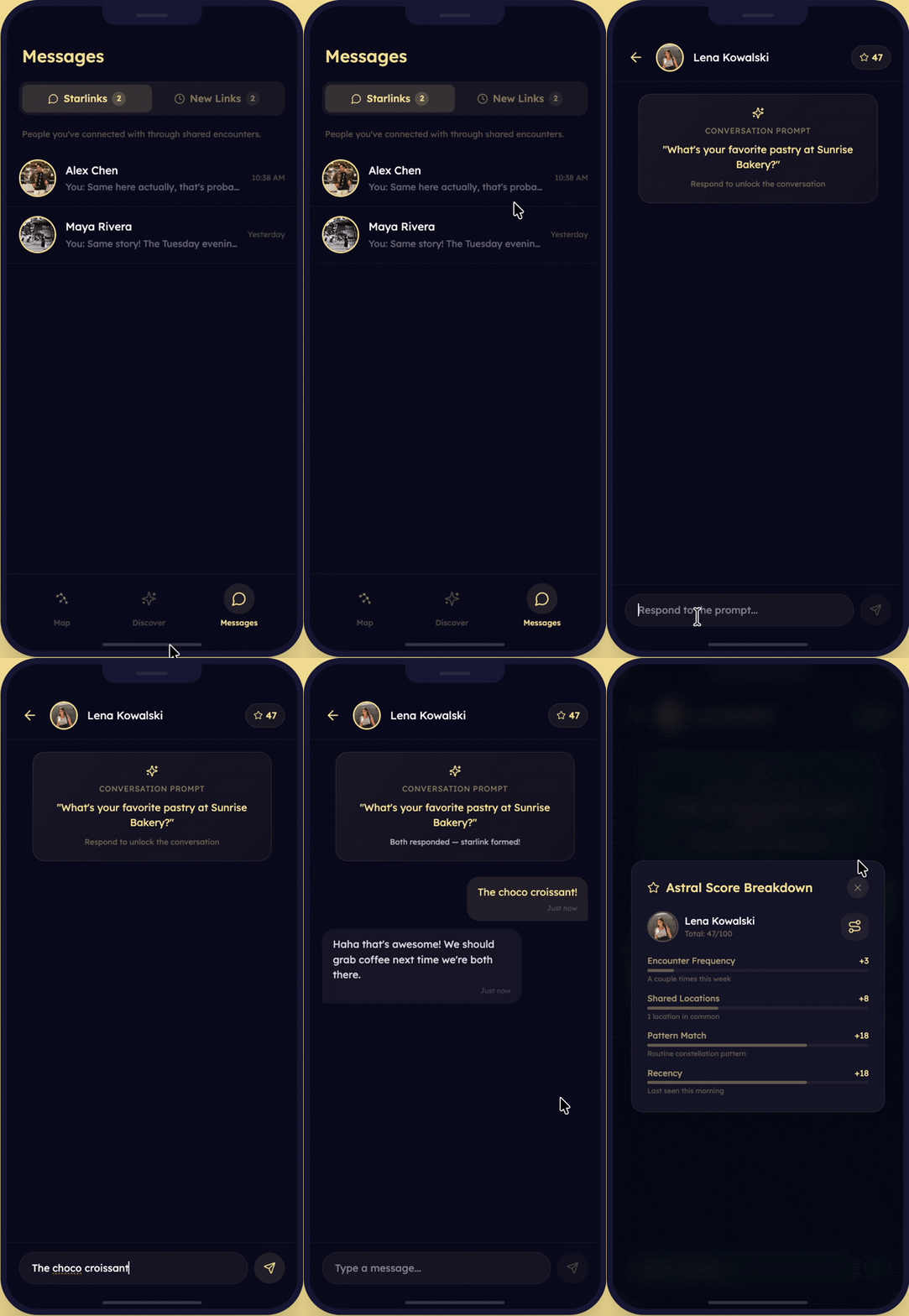
See all the users you’ve formed starlinks with and ones you may form starlinks with or not
Choose to respond to the given prompt to form a connection
Once both users respond, a starlink is formed
Safety Concerns
- Users remain anonymous until both people mutually accept a connection
- Align does not reveal exact real-time locations. Instead, it only shows shared encounter locations after multiple interactions
- Users must mutually match before messaging. The conversation begins with an AI-generated prompt based on places both users frequently visit, and both users must answer the prompt before the chat unlocks
DEMO VIDEO
Align - FigBuild 2026